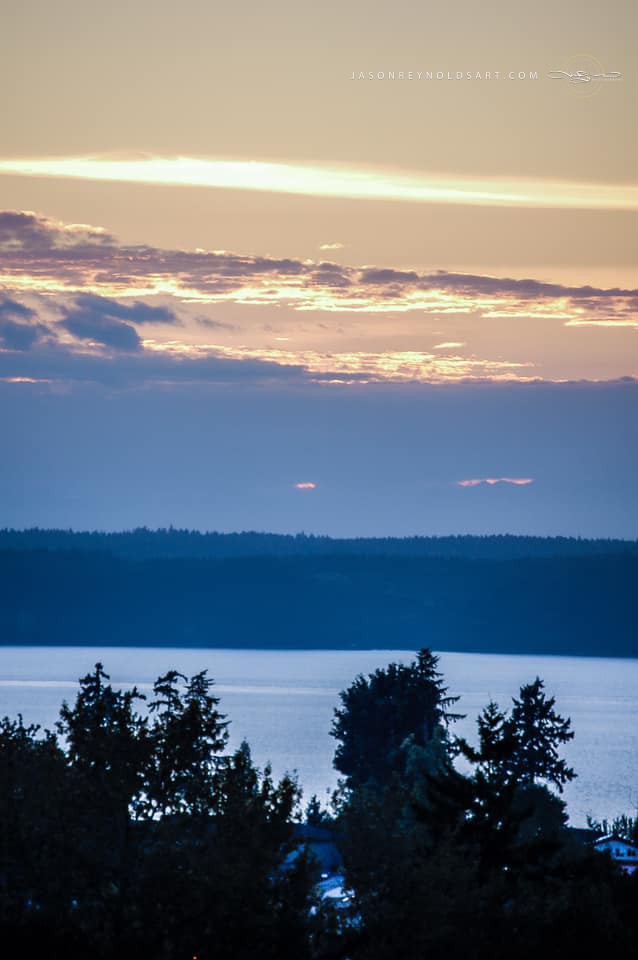
2005. This isn’t a particularly “good” photo.
It’s not a great composition, and there have been better sunsets to shoot.
But this is my very FIRST photo on a DSLR.
Since I was going into the graphic design business, I figured would need a good if not GREAT camera to shoot my own images.
Coming from a film camera, I had NO idea about ISO, no experience with things like light balance, and no real experience with photo-correction or any post-production process.
I wouldn’t even delete images I didn’t like. My ENORMOUS 1gb SD card (purchased for about $100) was filled with junk photos and good photos alike. I had assumed I would need to buy a new SD card when it got full. It didn’t occur to me to just delete the old pictures.
You just can’t do that with a film camera.
I would just find a composition I liked, turn the knob to the most similar “icon” on the camera to what I saw through the viewfinder and click the shutter.
I think this one was the “landscape” icon.
It would be years before I had the courage to try my hand at manual settings.
I picked out a Nikon D-50 as a starter camera. I figured since I already had a couple lenses from my old Nikon N-65 35mm film camera, I could just get a new body and use my existing lenses.
I was wrong. Apparently film camera lenses are completely incompatible with digital lenses.
I had to start over. It was not cheap.
Since purchasing my D-50, every camera since has been a Nikon. You cannot use Nikon lenses on Canon cameras, and visa-versa.
If I had to do it again, I probably would have gone with a Canon camera. People seem to like their Rebels and I am really impressed with their performance.
But, one thing I have learned being an artist, is that all the equipment in the world won’t give you an eye for good design… or finding a good composition.
You can make good art and take a good photo on a camera phone, a disposable camera, or even an old Polaroid.
You work with what you’ve got.
Behind all good photography is a good photographer.